


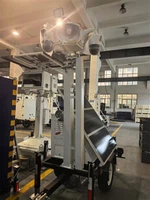


Diesel Mobile Light Tower


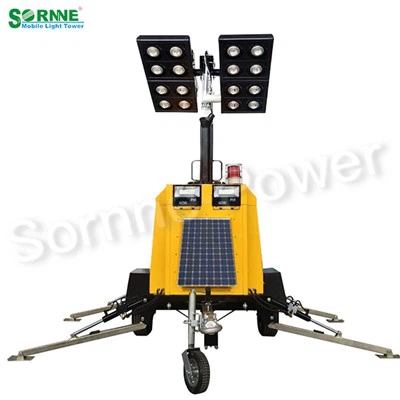


A diesel mobile light tower is a portable generator with a lighting component attached. The lights are usually attached to the mast, which is attached to a trailer, with a generator set to power the lamps. The diesel mobile light tower is always user-friendly because the diesel will continuously run until the refueling
Mobile light towers are often used as temporary area lighting systems where optimal visibility is crucial and grid-connected fixed lighting is costly or difficult to install. They can be used for a wide range of applications including large outdoor events, sports fields, construction and work sites, workshop, farming, logistics, rural and hard to reach areas and temporary public lighting.
Some benefits of mobile light towers include:
- Safe working environment
- Reduces noise in work area
- Safe and easy lifting operation
- Enable use of existing power for lights
- Long lamp life
- High efficiency and low amp draw after initial startup
- High durability and reliability
- High output and very good color rendering
- Vibration and shock resistant
- Low maintenance
Applications & Uses of Mobile Light Towers
Develop More Additional Lights on the Sites
Always be aware of choosing portable light towers whether it is branded or safe for your workers. Mainly Mobile light towers are manufactured by Operational Safety and Health Administration.
Portable light towers will give more gallons of light when compared to other light towers. If You are choosing Diesel rather than Electric or solar light towers there will be more benefits to your sites.

Arrangements and Shifting of Generator
Mobile light towers are otherwise called Small generators. The portable MLT has wheels that are completely movable from one place to another. When you keep mobile light towers outdoors, analyze the place and whether the place is looking good.

Fueling of Diesel Light Towers.
Mobile light towers with Diesel generators can produce power for your work site but the electric light towers need electricity to run. So the Diesel mobile light tower is always user-friendly. If the diesel has been filled in the generator it will continuously run until the refueling.

Diesel Powered Mobile Light Towers.
This mobile light tower is used in construction after sunsets.MLT is very useful in darkness and reduces the lack of light. There are many Uses of Mobile Light Towers and MLT is the best friend for construction site workers and helps to complete the production. It also prevents accidents for site workers.
The performance characteristics of the mobile lighting tower
The unique large square lampshade design allows the light to be emitted in a straight line, providing the best lighting effect for the construction site. Without any tools, each lamp can be adjusted independently. The fast power connection provides easier disassembly for preparation before transportation. The main mast that can rotate 360 degrees allows the light to be adjusted according to different needs after being raised. The compact and enhanced lighthouse provides extraordinary lighting. The enhanced and trailer-type lighthouse features a compact and lightweight design that makes transportation easy and easy.
Four 1000 watt metal halide lamps or sodium lamps and LED lamps are used. The lamp holder can arbitrarily change the projection angle within the range of 0°~90° in the vertical direction. The light pole rises: 7 meters. Rise time: 50S. Fall time: 20S. The light coverage radius can reach 120 meters-150 meters.
The light pole can be rotated and adjusted by 360° in the horizontal direction, and there is no dead angle for 360° irradiation. The light pole is integrated with the body, and the light pole must be kept in a vertical position after it is lowered, and it is not allowed to be folded for transportation or movement.
Control switches, control display screens, and indicating instruments are all integrated on the same panel, which is convenient for operators to operate and monitor in real time.
Fully automatic operation, independent one-key automatic control of engine start, lamp pole lifting, hydraulic foot retracting and releasing, lamp switch.
The whole set of lighthouse adopts 4 hydraulic supporting feet and adopts a fully automatic operation design. When the supporting feet are retracted, they can be locked with a pin buckle and will not be accidentally released. After the hydraulic feet are deployed, they can support a load of more than 1400kg, and each support foot can carry 350kg (one-button automatic deployment feet). It can ensure safe work under 8 strong winds.
Lamp power: 4×1000W; luminous flux: 4×100000lm; electrical performance: 220V50Hz; vertical turning (electric): 0°~90°; enclosure protection level: IP65.
Engine parameters: select 0# diesel, engine rated power 7.2KW (50Hz); generator parameters: fuel consumption: 2Lh; fuel tank volume: 80L; continuous working time: 40h; electrical system: 12V; noise (7 meters): 75db , Insulation resistance is 400 megohms.
Packed dimensions (length×width×height): 3232×1478×2472mm; wind resistance level: 8 (75kmh); in order to increase transportation stability, total weight requirement: 1500kg; maximum towing speed: 80km/h; There are two taillights at the rear of the lighthouse, which are connected to the power vehicle to achieve braking and lighting functions; the trailer must have a braking device to ensure that the lighthouse is used and mobile storage.
The main service industries and scenarios of mobile lighting towers
Construction lighting is used in engineering construction, urban construction pipelines, road paving, road maintenance, road rescue;
Emergency lighting is used in emergency rescue, earthquake preparedness, armed police fire protection, earthquake disaster relief, flood prevention and rescue;
Combat readiness lighting is used in combat readiness emergency, various rescues, field training, camping and distributing;
Mine lighting is used in open-pit mine lighting, mine tunnel lighting, distributed storage and transportation, and camping in mines;
Mobile lighting used in sports events, film and television shooting, airport backup, railway power;
Emergency lighting is used in transportation, electricity, water pipe, gas, and telecommunications construction.

Why You Need to Have Mobile Lighting Towers for Your Site
In the early 1990s working in low-light conditions was nothing new. Today, light towers are ubiquitous on our aging highways, and we frequently see teams of staff working late into the night to ensure that drivers have as little effect as possible.
Around the world, light towers provide lighting in difficult, even dangerous situations. With strong demand for project completion and constant night work to keep projects on track, we have a lot on our plate.
There is a need for a long-lasting light source that can illuminate work areas efficiently. Staff would be able to finish work safely and easily at night, So the role of the mobile light towers have been increased day by day.
Can Mobile Light Towers Be Used as a Generator?
Mobile Light towers are diesel generators with a lighting component attached. In most instances and the power source for the running lights, the light tower has an additional power source. Most light towers can now be used as small generators, making them multifunctional structures.
Light towers are frequently overlooked on the construction site until they need to be turned on or off. However, when the sun begins to set, the light tower, like flashlights in dark alleys, becomes one of the most important products on construction sites.

WHAT ARE PORTABLE LIGHT TOWERS USED FOR?
Portable light towers are used to provide lighting in a number of settings like construction sites, mines, warehouses and sporting events. Since they’re portable and generate their own power, light towers are essential in situations where electricity is unavailable.
Here are some of the most popular uses for portable light towers:
- Outdoor events and concerts
- Construction sites
- Roadwork and maintenance
- Emergency response and disaster relief
- Mining and exploration sites
- Film and television productions
- Sports fields and arenas
- Military operations
- Parking lots and garages
- Agricultural operations and farming
- Nighttime security and surveillance